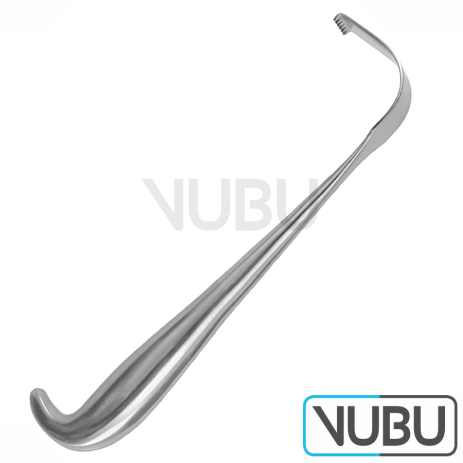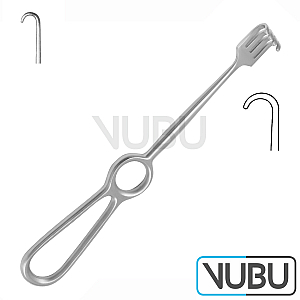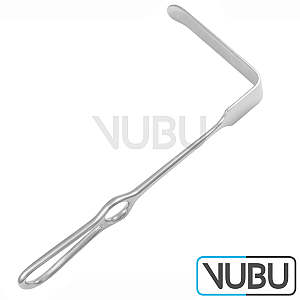


Large-Surface, Fine-Toothed Retractor for Stable Soft Tissue Retraction in Deep Orthopedic and Spinal Surgical Procedures
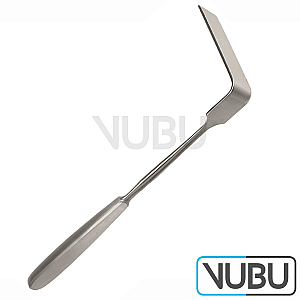
The MEYERDING RETRACTOR Type FIG-2 (75 mm x 25 mm / 22.5 cm) is a Class I medical device manufactured according to ISO 13485:2016. This larger and wider variant of the fine-toothed Meyerding retractor is designed for the secure and powerful retraction of larger soft tissue masses from bony structures in deep surgical approaches. The large-surface, toothed blade provides optimal holding power with minimal point loading of the tissue.
Product Highlights:
✔ Manufactured in accordance with ISO 13485:2016
✔ CE Marked – Class I (Regulation (EU) 2017/745 – MDR)
✔ Large, fine-toothed blade (FIG-2 Type) for secure grip on extensive muscle and ligament structures
✔ Large-surface blade shape (75 mm x 25 mm) for stable retraction of larger soft tissue areas in depth
✔ Robust overall length of 22.5 cm for direct force transmission and control during demanding retraction
✔ High-quality, solid and hardened surgical stainless steel for extreme durability and sharp tooth edges
✔ Precision-manufactured, sharp teeth across the entire blade width for uniform and secure force distribution
✔ Reinforced blade-shaft junction for increased stability under load
✔ Atraumatic rounded blade tip and blade ends
✔ Ergonomic, large and closed finger ring for powerful grip with the whole hand
✔ Matte, anti-reflective surface
✔ Sterilizable and reusable
Benefits of the Meyerding Retractor FIG-2:
• Excellent Holding Power for Large Soft Tissue Masses: The large, toothed surface provides a secure grip for retracting powerful muscles (e.g., erector spinae, gluteal muscles) during hip or spinal procedures.
• Optimal Deep Retraction: The 75 mm length allows reaching and securely holding tissue in deeper layers, e.g., during dorsal lumbar fusions or revision arthroplasty.
• Even Pressure Distribution: The 25 mm width distributes retraction force over a large area, minimizing the risk of pressure necrosis or tissue tearing.
• Reduced Slipping: The fine teeth ensure reliable grip even in a wet/bloody surgical field and prevent dangerous slipping during the use of oscillating saw blades or chisels.
• Robust Instrument for Demanding Procedures: Constructed for repeated use in challenging orthopedic and trauma procedures.
Technical Specifications:
• Type: Meyerding Retractor / Fine-Toothed Large-Blade Retractor (Type FIG-2)
• Blade Dimensions: 75 mm (Length) x 25 mm (Width)
• Teeth: Fine-toothed (multiple fine teeth along the entire blade edge)
• Overall Length: 22.5 cm
• Blade Shape: Large, wide and flat, with continuous fine teeth and rounded corners
• Material: Solid, hardened Surgical Stainless Steel 1.4301 or 1.4104
• Surface Finish: Matte (satin finish)
• Handle: Large, closed oval ring for full hand
• Sterilization: Autoclavable up to 138°C (Steam Sterilization)
• Packaging: Individually packed in sterilizable peel pouch
• Risk Class: I according to Regulation (EU) 2017/745 (MDR)
Areas of Application:
• Extensive dorsal spinal procedures (e.g., multisegmental fusions, scoliosis corrections)
• Primary and revision hip arthroplasty (e.g., posterior approach)
• Orthopedic tumor surgery on extremities
• Trauma surgical procedures with major soft tissue damage (e.g., open fractures)
• All orthopedic and trauma surgical procedures requiring stable retraction of large muscle groups
Important Safety and Handling Information:
• FOR USE BY EXPERIENCED ORTHOPEDIC OR TRAUMA SURGICAL PROFESSIONALS ONLY.
• Targeted Placement: The large blade requires conscious placement to avoid unintentionally compressing or entrapping neurovascular structures. The teeth are intended for muscular and ligamentous tissue.
• Controlled Force Application: Despite the robust construction, force should be applied in a measured and controlled manner to avoid excessive tissue crushing.
• Protect the Teeth: Avoid contact of the teeth with other metal instruments during use and reprocessing to prevent blunting.
• Intensive Cleaning: Due to the large toothed surface, thorough cleaning with an appropriate brush after each use is essential to remove dried tissue and blood residues.
• Regular Inspection: Before each use, inspect for damage to the teeth (broken, bent) and for cracks in the material, especially at the junction to the shaft.
Write the first Review!


All instruments are certified according to: