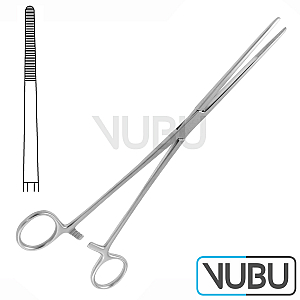


VUBU-Medical sources swab, sponge and dressing forceps from Tuttlingen, an established centre for surgical instrument manufacturing. See the product or manufacturer documentation for details on a specific model.
See the EU Declaration of Conformity for CE marking information for the specific product. The manufacturer’s documentation provides information on its quality management system and applicable standards.
Before dispatch, we check jaw alignment, joint movement, the locking mechanism where fitted, and the surface finish. Follow the manufacturer’s instructions for preparation before first use.
Our reviews page includes feedback on VUBU-Medical instruments and ordering service.
Medical professionals, clinics, hospitals and procurement departments can order on invoice through VUBU-Medical.
The range covers 13 to 36 cm and includes straight, curved and S-shaped instruments, with smooth or serrated jaws and locking or non-locking versions, depending on the model.
The range includes instruments for professional surgery and wound care. For use in a professional piercing studio, check the intended purpose and specifications of the particular model.
Tanja O. praised the cutting performance of the scissors.
Michaela L. was pleased with the price and quality.
Markus S. reported that the blades fit the handles.
Compare surgical stainless steel patterns by length, curvature, jaw profile and locking mechanism.
The Bozemann pattern is available in straight and S-shaped versions, both 26 cm long. The two designs offer different working angles.
The Bozemann–Douglas pattern measures 26 cm and offers an alternative handle and working-end configuration.
The curved Bryant measures 13 cm and is one of the shortest models in the range.
The 25 cm Cheron pattern is designed to hold swabs and dressing material.
The Collin pattern measures 24 cm and is designed for handling dressings.
Both versions measure 20.5 cm. Compare the straight and curved working ends for the access required.
The Fletcher is available in straight and S-shaped versions, both 24 cm long.
The narrow-jaw Foerster is available in straight and curved versions at 25 cm. The narrow profile is useful when comparing options for smaller swabs or limited working space.
The Foerster–Ballenger range includes straight and curved versions, serrated or smooth jaws and overall lengths from 18 to 36 cm. Serrations provide additional grip on damp swabs or sponges.
Gross–Maier dressing forceps are used to handle dressings and packing material. The range includes straight and curved models from 20 to 27 cm, with or without a ratchet lock. A locking version holds the jaws closed until released.
Swab and sponge forceps let staff handle dressing materials with the instrument. Compare the working-end geometry and overall length for the intended access.
Swab forceps can hold applicators during skin preparation. Check the intended use and jaw profile when selecting a model for the material being handled.
During surgery, surgical swab forceps are used to hold and position swabs or sponges. Longer models, such as the 36 cm Foerster–Ballenger, provide additional reach.
Compare Bozemann, Bozemann–Douglas and other patterns by working angle and intended purpose. Related instruments include dissecting and ligature forceps and tissue grasping forceps for other handling tasks.
The 25 and 36 cm Foerster–Ballenger models offer different working lengths for handling swabs and dressings. For specialist instruments, see our ENT forceps range.
For holding skin folds in a professional piercing setting, check whether the intended purpose and jaw design of the individual instrument suit the application.
The instruments are made of surgical stainless steel. See the individual product page for material details.
Check the manufacturer’s instructions for compatible cleaning agents, disinfection processes and sterilisation methods for each model.
Serrated jaws provide additional grip on damp swabs or sponges. Smooth jaws offer a flatter contact surface for handling dressing materials.
Straight, curved and S-shaped patterns offer different working angles. Compare the shape and length for the intended access.
The range extends from the 13 cm Bryant sponge forceps to the 36 cm Foerster–Ballenger sponge forceps.
Gross–Maier dressing forceps are available with or without a ratchet lock. A ratchet holds the jaws closed until released. On the non-locking version, the jaws are controlled directly by the handles.
Ring handles support controlled opening and closing. Compare handle and lock design on the individual model.
Follow the instructions for reusable surgical instruments and your facility’s validated reprocessing procedures after use. Refer to the documentation for the specific model.
Follow the manufacturer’s instructions for the timing and method of pre-cleaning, including any requirements for the jaws, joint and locking mechanism.
Use the cleaning and disinfection methods approved for the individual instrument. Follow the instructions for the joint, jaws and lock, as applicable.
Check for damage, corrosion and functional issues as specified in the instructions for use. Remove damaged instruments from service.
Use the sterilisation method and cycle parameters specified for the individual model. Related products are available in our sterilisation instruments and accessories range.
Store sterilised instruments in suitable packaging or containers according to your facility’s procedures.
For reprocessing information, see the instructions for use for reusable surgical instruments. Consult the documentation for the specific model in our surgical instrument range.
The names overlap. Swab and sponge forceps are used to handle swabs, sponges and dressings. Dressing forceps, including Gross–Maier patterns, are also used for packing material. Compare the exact jaw profile and intended purpose of each model.
Serrated jaws provide additional grip on damp materials. Smooth jaws offer a flatter contact surface. Choose the profile for the material and intended purpose.
The range runs from 13 cm for the Bryant to 36 cm for the longest Foerster–Ballenger pattern. Compare overall length, working-end shape and reach for the intended access.
The instruments are designed for reuse. The manufacturer’s instructions for the specific model identify the permitted cleaning, disinfection and sterilisation methods and cycle parameters.
The ratchet on a locking model holds the jaws closed until released. On a non-locking model, the jaws open and close directly with the handles.
Check the intended purpose and specifications for the individual model. Bozemann, Bozemann–Douglas and Foerster–Ballenger patterns offer several working angles and lengths. Related instruments include hysterectomy and parametrial clamps from our range.
See the EU Declaration of Conformity for the product’s CE marking information and the manufacturer’s documentation for details of its quality management system.
Yes. VUBU-Medical offers payment by invoice to medical professionals, clinics, hospitals and businesses. Available payment options are shown at checkout. Shipping within Germany is free for orders with a goods value of €100 or more.


All instruments are certified according to: