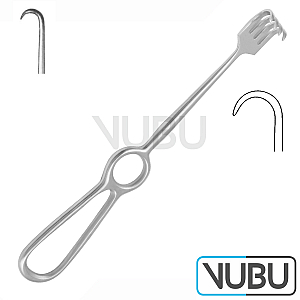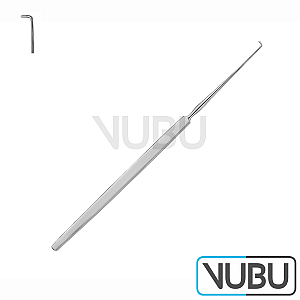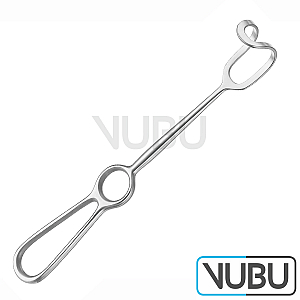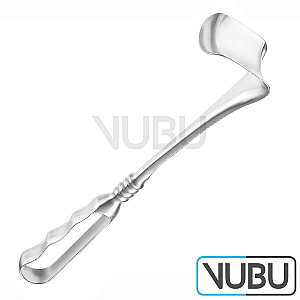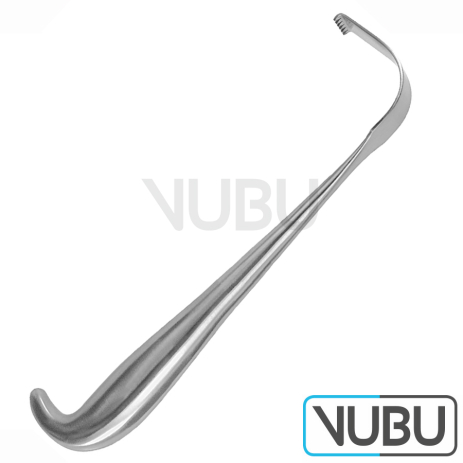


Monumental Wide-Blade Retractor with Fine Serration for Maximal Soft Tissue Retraction in Orthopedic Revision Surgery, Tumor Surgery and Complex Spinal Surgery
The MEYERDING RETRACTOR Type FIG-3 (90 mm x 50 mm / 22.5 cm) is a Class I medical device manufactured according to ISO 13485:2016. This extremely wide and long, fine-toothed retractor defines the top performance class for mastering the largest soft tissue masses and creating the deepest, most stable surgical fields. Designed for the most demanding orthopedic, tumor surgical, and trauma surgical procedures where conventional retractors fail.
Product Highlights:
✔ Manufactured in accordance with ISO 13485:2016
✔ CE Marked – Class I (Regulation (EU) 2017/745 – MDR)
✔ Monumental, fine-toothed wide blade (FIG-3 Type) – Maximum holding surface for extreme soft tissue masses
✔ Exceptional blade dimensions (90 mm long x 50 mm wide) for exposing the largest possible areas
✔ Compact, powerful overall length of 22.5 cm for direct and controlled force transmission
✔ High-quality, solid special steel with ultra-high hardness – for unsurpassed stability and permanently sharp teeth
✔ Precision fine serration along the entire blade edge for uniform, non-slip grip without tissue damage
✔ Reinforced, solid blade-shaft junction with double material thickness for highest load capacity
✔ Fully rounded blade edges and corners for atraumatic contact
✔ Extra-robust, large-volume double-ring handle construction for two-handed use and maximum leverage
✔ Deep-matte, absolutely reflection-free surface
✔ Sterilizable and designed for long-term use in high-performance ORs
Benefits of the Meyerding Retractor FIG-3:
• Ultimate Holding Power and Areal Control: The 50 mm width and 90 mm length create an unsurpassed contact area to securely and stably retract even the largest muscle complexes (e.g., entire gluteal musculature, quadriceps).
• Creation of Deepest and Widest Surgical Fields: Enables exposure of extensive bony structures (e.g., entire pelvis, femoral shaft, long spinal segments) with previously unattainable quality and stability.
• Perfect Pressure Distribution: Prevents local pressure points and thus the risk of muscle ischemia, nerve compression, or soft tissue necrosis in lengthy procedures due to the enormous surface area.
• Indispensable in Revision and Tumor Surgery: Specifically developed for procedures with extensive scar tissue, large tumor resection beds, or complex reconstructions where normal tissue is missing and grip is difficult.
• Drastically Reduces Assistant Need: Due to its size, it can often replace two or three standard retractors, simplifies setup, and improves overview for the entire team.
Technical Specifications:
• Type: Meyerding Retractor / Fine-Toothed Mega Wide-Blade Retractor (Type FIG-3)
• Blade Dimensions: 90 mm (Length) x 50 mm (Width)
• Teeth: Fine-toothed (multiple, precisely formed teeth along the entire blade edge)
• Overall Length: 22.5 cm
• Blade Shape: Extremely wide and long, rectangular-flat, with continuous fine serration
• Material: Solid, ultra-high hardness special steel (e.g., 1.4112 or comparable)
• Surface Finish: Deep matte (Super-Satin Finish)
• Handle: Extra-robust double-ring construction for two-handed or assisted use
• Sterilization: Autoclavable up to 138°C (Steam Sterilization)
• Packaging: Individually packed in a robust, sterilizable special tray with form recess
• Risk Class: I according to Regulation (EU) 2017/745 (MDR)
Areas of Application (for Maximal Procedures):
• Orthopedic Revision Surgery of Hip and Knee with Extensive Access and Scar Tissue
• Orthopedic Tumor Resections in the Pelvic and Thigh Region
• Complex Dorsal Spinal Procedures for Extensive Deformities or Revision Cases
• Trauma Surgical Management of Complex Pelvic Fractures and Multi-Fragment Fractures of Long Bones
• Amputation and Replantation Surgery of the Lower Extremity
Critical Safety and Handling Information (ESSENTIAL):
• FOR USE BY HIGHLY EXPERIENCED ORTHOPEDIC, TRAUMA SURGICAL, OR TUMOR SURGICAL TEAMS ONLY. Requires specific knowledge of anatomy and retraction techniques.
• Conscious and Controlled Placement: Due to the enormous size, precise, anatomically planned placement is mandatory to avoid compressing or overstretching large neurovascular bundles (e.g., sciatic nerve, femoral vessels).
• Teamwork Required: Inserting and holding this instrument typically requires coordinated two-handed or assisted use.
• Tissue Sparing is Priority: Despite the robust construction, retraction force must be consciously dosed. The serration is for grip, not for penetrating tissue.
• Special Reprocessing: The large blade requires thorough manual pre-cleaning and should be separated from other instruments and cleaned in large, flat mesh trays to avoid damage.
• Inspection Under Load: Before each use, the instrument must be inspected for material fatigue, cracks (especially at the handle junction), or bent teeth.
• Sterilization Logistics: Requires special, large-volume sterilization containers.
Write the first Review!


All instruments are certified according to: