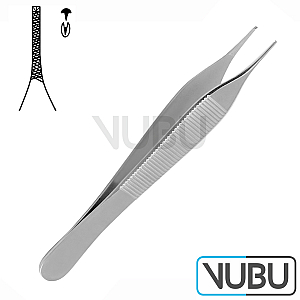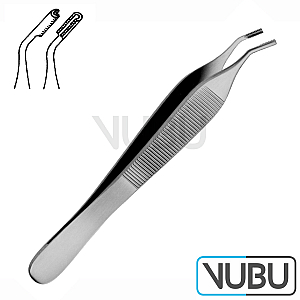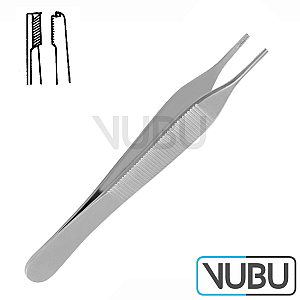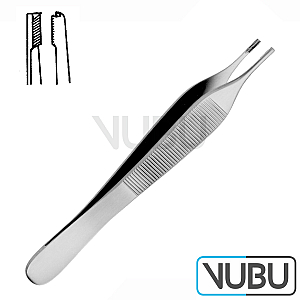


Surgical tissue forceps from VUBU-Medical are dispatched from Tuttlingen, an established centre for surgical instrument manufacturing.
See the EU Declaration of Conformity for the specific product and the manufacturer’s documentation for details of its quality management system.
The range includes standard patterns and models with tungsten carbide (TC) inserts. Check the product documentation for material and origin.
Our range of surgical instruments includes Adson, Bonney and other tissue forceps in several lengths and tooth configurations.
Medical practices, clinics and hospitals can order on invoice. See individual product pages for availability and estimated delivery. Shipping within Germany is free from €100 in goods value.
The service team is available Monday to Friday, 09:00 to 18:00 German local time, at +49 7462 94 44 86 for questions about models, sizes and tooth configurations.
Visit the reviews page for customer feedback on the VUBU-Medical range and ordering service.
Michaela L. praised the price and quality and said she would order more instruments.
Marion T. praised the quick delivery and quality.
Natalia C. thanked VUBU-Medical for the prompt delivery of the clamps.
Nina B. reported being very satisfied.
Compare the patterns below by overall length, tooth configuration, tip geometry and insert material.
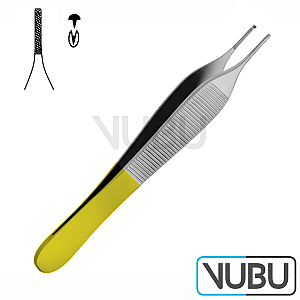
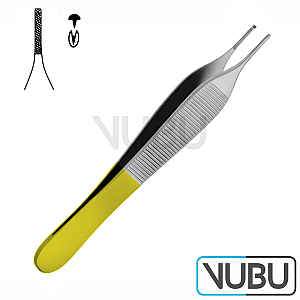
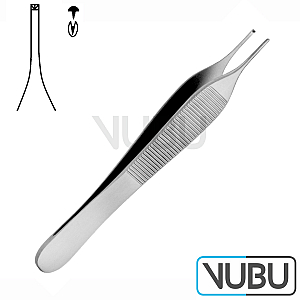
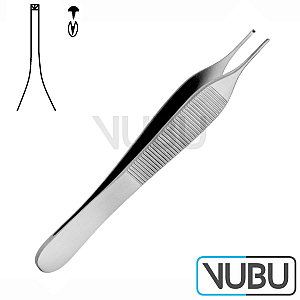
Cross-serrated pattern with 1 × 2 teeth. Available in 12 and 15 cm, including versions with tungsten carbide inserts.
The 12 cm range includes straight and curved versions with 7 × 7 or 9 × 9 teeth. Compare the tooth profile for the intended application.
The 18 cm Bonney is available with 1 × 2 or 2 × 3 teeth. The range also includes versions with TC inserts.
Available in lengths from 15 to 25 cm, with 2 × 3 or 4 × 5 teeth depending on the version.
Straight and curved versions, each 20 cm long, with 1 × 2 teeth.
This tissue forceps pattern is available in 15 and 20 cm lengths.
The Oehler pattern is listed with TC inserts and is designed for fine skin and tissue handling.
These patterns offer different tip geometries. Check the intended purpose and specifications for each model.
Compare the intended purpose, tissue type and planned access with the length, tooth configuration and tip geometry of the specific instrument.
Bonney and Adlerkreutz offer several tooth configurations. Compare their specifications for the intended tissue handling task. For related instruments, see our surgical clamps and forceps range.
Compare Adson, Adson–Brown and Oehler patterns by working-end geometry and intended purpose. For related products, see our plastic surgery instruments.
The Cushing pattern is available for comparison by tip profile and length. Use the stated intended purpose of the individual model to guide selection.
For vascular procedures, choose instruments specifically intended for the planned application. Check the specifications of the individual Potts–Smith model.
The Oehler hook pattern with TC inserts is designed for fine skin and tissue handling. Check the exact tip profile and intended purpose.
The 20 cm Brophy pattern comes in straight and curved versions. For related instruments, see our maxillofacial instruments.
Compare the material, working-end geometry and manufacturer’s instructions for the individual instrument.
See the product page for material details and the manufacturer’s instructions for approved reprocessing methods.
Selected Adson, Bonney and Oehler models feature wear-resistant tungsten carbide inserts.
Compare overall length and reach. Straight and curved designs are available, depending on the model.
Compare the features below against the tissue type, intended purpose and planned access.
Reprocess reusable instruments according to the manufacturer’s instructions. For storage options, see our sterilisation containers range.
Follow the manufacturer’s instructions for the timing and method of pre-cleaning, including any requirements for teeth and serrated surfaces.
Use only the cleaning methods and accessories approved for the individual model.
Follow the model-specific instructions for rinsing and drying before sterilisation.
Check tip alignment, tooth engagement, surfaces and inserts as specified in the instructions for use. Remove damaged instruments from service.
Follow the approved sterilisation process and packaging requirements for the specific instrument. Instructions for use are available on VUBU-Medical.de.
Store reprocessed instruments in suitable packaging according to your facility’s procedures. Sterilisation cassettes and compatible containers are available in the shop.


All instruments are certified according to: