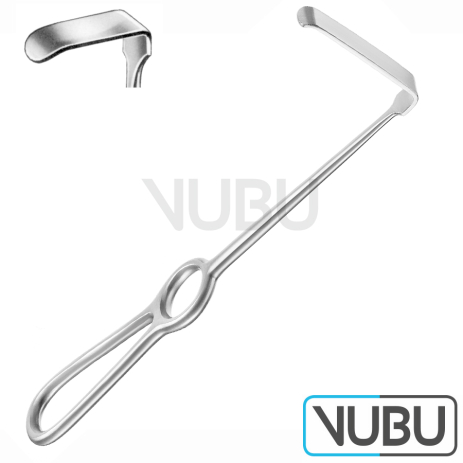


Tall-Blade Combination Retractor for Deep Retraction with Secure Fascial Fixation
The KOCHER-LANGENBECK RETRACTOR 35mm x 11mm is a CE-Class I medical device manufactured according to ISO 13485:2016. This tall-blade variant of the classic dual-function retractor combines an exceptionally tall Langenbeck blade with the toothed grasping function of a Kocher blade. The design is specifically developed for procedures requiring deep, forceful tissue retraction combined with precise control of fascial structures.
Product Highlights:
✔ Certified according to ISO 13485:2016
✔ CE Marking Class I (Regulation (EU) 2017/745)
✔ Tall-blade variant of the universal Kocher-Langenbeck retractor
✔ Extra-tall Langenbeck blade (35x11mm) for deep retraction of voluminous tissue layers
✔ Reinforced 1- or 2-toothed Kocher blade for secure grip under tension
✔ High-quality surgical stainless steel 1.4301 – rust-proof and biocompatible
✔ Tested Biocompatibility according to ISO 10993
✔ Solid one-piece forged construction for maximum load capacity
✔ Optimal length (21.5 cm) for deep anatomical regions in orthopedic and visceral surgery
✔ Sterilizable and reusable
Advantages of the Kocher-Langenbeck Retractor (35x11mm):
• Deep Retraction: The 11 mm tall Langenbeck blade enables effective retraction of deeply located or adipose tissue.
• Dynamic Adaptation: Instant switching between powerful area retraction and precise grasping retraction without instrument change.
• Powerful Exposure: Ideal for procedures with strong tissue tension such as in orthopedics, trauma surgery, or bariatric surgery.
• Reduced Instrument Changes: Increases OR efficiency by combining two essential retraction techniques.
• Secure Handling: The central, ergonomic handle allows precise rotation and secure grip even under high traction.
Technical Specifications:
• Model: Kocher-Langenbeck Retractor, Tall-Blade Variant
• Overall Length: 21.5 cm
• Blade 1 (Langenbeck): Broad and tall, 35 mm x 11 mm
• Blade 2 (Kocher): Reinforced, 1- or 2-toothed grasping blade
• Material: Stainless Surgical Steel 1.4301 / AISI 304
• Construction: Forged from one piece, high-load capacity
• Blade Shape: Asymmetric – one side tall and flat, one side toothed
• Handle: Central, thickened handle with safety grooves for fatigue-free grip
• Surface: Matte (satin finish), anti-glare and corrosion-resistant
• Special Feature: Specialized for deep, force-intensive procedures with varying retraction needs.
• Risk Class: I according to Regulation (EU) 2017/745 (MDR)
Primary Fields of Application:
• Orthopedics & Trauma Surgery: Hip arthroplasty, femoral nailing, shoulder surgery, spinal procedures with strong muscle retraction.
• Visceral Surgery (Bariatric Surgery): Retraction of the thick abdominal wall in bariatric procedures or major laparotomies.
• Vascular Surgery: Deep exposure of femoral or pelvic vessels.
• Urology: Radical prostatectomy or cystectomy with deep pelvic access.
• Plastic & Reconstructive Surgery: During flap procedures with voluminous subcutaneous tissue.
Extended Safety and Application Notes:
• FOR USE BY EXPERIENCED SURGEONS AND OPERATING ROOM ASSISTANTS ONLY.
• Use Kocher blade with extreme caution: Apply only to definitively fascial, tendinous, or periosteal structures. Absolutely contraindicated for parenchymal organs, nerves, or major vessels.
• The tall Langenbeck blade requires conscious, broad-surface positioning to avoid tissue crushing at the blade edges.
• Due to the leverage effect, controlled, measured traction is essential to prevent unintended tissue damage.
• Inspect for material fatigue or deformations before each use, especially at the transition between handle and blade.
• During reprocessing, both blade types and particularly the interdental spaces of the Kocher blade must be intensively cleaned.
Write the first Review!


All instruments are certified according to: