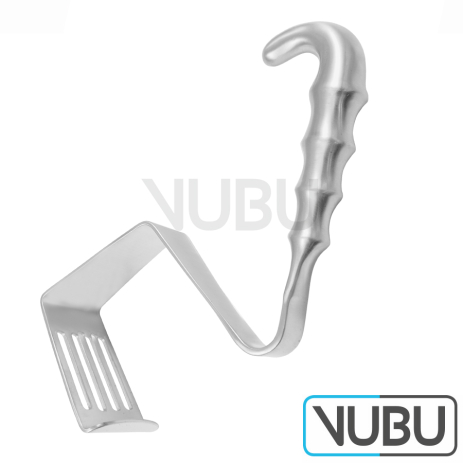


High-Stability Deep Retractor for Extreme Soft Tissue Exposure in Shoulder, Hip and Spinal Surgery
The DAVIDSON RETRACTOR 75 mm x 90 mm / 16.0 cm is a Class I medical device manufactured according to ISO 13485:2016. With an exceptional blade depth of 90 mm, this variant of the Davidson retractor is specifically designed for retracting large and powerful soft tissue masses in the deepest anatomical spaces. Its monumental depth provides unparalleled stability for the most demanding orthopedic reconstructions.
Product Highlights:
✔ Manufactured in accordance with ISO 13485:2016
✔ CE Marked – Class I (Regulation (EU) 2017/745 – MDR)
✔ Monumental blade depth (90 mm) with compact width (75 mm) – for ultimate deep retraction
✔ Short, powerful lever length of 16.0 cm for maximum control and direct force transmission
✔ High-quality, solid and reinforced surgical stainless steel – engineered for extreme loads
✔ Deep, double-angled blade design for optimal hold and visibility in deep joint and vertebral body approaches
✔ Reinforced blade edges and rounded tips for atraumatic contact under high load
✔ Ergonomic, robust finger ring for a secure, powerful grip
✔ Matte, reflection-free surface
✔ Sterilizable and designed for use in high-performance procedures
Benefits of the 90mm Deep Davidson Retractor:
• Unparalleled Deep Retraction: The 90 mm blade depth allows reaching and stably holding tissue in the deepest layers of the glenohumeral joint, acetabulum, or along the spine.
• Maximum Stability in Depth: Creates an extremely stable retraction wall that securely holds back even powerful muscle groups (e.g., deltoid, gluteal muscles, erector spinae) and ensures a vibration-free operative field.
• Ideal for Revision and Tumor Surgery: Particularly valuable in procedures with extensive scar tissue, large soft tissue defects, or during bone tumor resections where conventional retractors fail.
• Optimized Exposure for Implants: Provides perfect visibility of deep-lying bony landmarks crucial for the precise positioning of prosthetic components, plate systems, or vertebral body replacements.
• Reduces Instrument Cluttering: Due to its depth, it can often replace multiple shallower retractors, optimizing space in the surgical field.
Technical Specifications:
• Type: Davidson Deep Retractor / High-Stability Skeletal Retractor
• Blade Dimensions: 75 mm (Width) x 90 mm (Depth/Height)
• Overall Length: 16.0 cm
• Blade Shape: Compact in width, extremely deep and double-angled (U- or C-shaped), with reinforced side panels
• Material: Reinforced Surgical Stainless Steel 1.4301 or 1.4441
• Surface Finish: Matte (satin finish)
• Handle: Robust, closed oval ring
• Sterilization: Autoclavable up to 138°C (Steam Sterilization)
• Packaging: Individually packed in sterilizable peel pouch
• Risk Class: I according to Regulation (EU) 2017/745 (MDR)
Areas of Application:
• Complex Shoulder Revision Surgery and Reverse Shoulder Arthroplasty
• Acetabular Revision Surgery with Major Bone Defects
• Spinal Surgical Procedures with Dorsal Approaches to Deep-Lying Vertebral Bodies
• Orthopedic Tumor Resections on Proximal Extremities and Pelvis
• Trauma Surgical Management of Complex Joint Fractures with Soft Tissue Damage
Critical Safety and Handling Information (Critical!):
• FOR USE BY HIGHLY EXPERIENCED ORTHOPEDIC AND TRAUMA SURGERY SPECIALISTS ONLY.
• Risk of Neurovascular Compression: The extreme depth carries an increased risk of compressing deep-lying nerves and vessels (e.g., brachial plexus, sciatic nerve, vertebral artery). Placement must be under direct vision and with knowledge of the 3D anatomy.
• Controlled Force Application Essential: The short lever length combined with the deep blade surface generates enormous leverage. Application must be extremely dosed and conscious to avoid bony avulsions or tissue tears.
• Preoperative Image Analysis Recommended: Use should be planned based on CT or MRI images to account for the patient's individual anatomy and the precise retraction direction.
• Rigorous Material Inspection: Before EACH use, the instrument must be inspected for deformations, micro-cracks, or material fatigue, especially at the highly stressed angled transitions.
• Thorough Manual Cleaning: Due to the complex, deep shape, intensive manual pre-cleaning is required to remove tissue residues in the angles.
Write the first Review!


All instruments are certified according to: