

VUBU-MEDICAL specializes in medical instruments, offering more than 30,000 variants of surgical tools for hospitals, medical practices and operating centers. We focus on consistent instrument quality, reliable availability and expert product selection.
From a simple needle holder to a laparoscopic instrument, from a mosquito forceps to an aortic clamp – we offer a broad selection of surgical instruments. This helps clinical buyers streamline their procurement.
Our instruments are described as being made from hardened, corrosion-resistant stainless steel and compliant with the European Medical Device Regulation (MDR). They are designed for repeated autoclave sterilization and professional clinical use.
Each instrument is checked for function, surface finish and smooth operation before dispatch – an important measure to help prevent failures in daily operating-room use.
VUBU-MEDICAL supplies hospitals, surgical centers, medical practices and veterinary facilities. Bulk orders, customized instrument selections and recurring supply agreements are available.
Our product range includes dimensions, material information and technical specifications to help medical buyers make informed purchasing decisions.
“Very affordable and really good. We will order more instruments here.”
“The blades fit the handles perfectly, especially at this price. Thank you.”
“We ordered several specula for our practice. Very satisfied with the quality.”
“We ordered 15 of these cannulas. They arrived well packaged. Thank you.”
“We are satisfied with the quality and can recommend this shop.”
“Everything went smoothly. I will order again.”
All surgical instruments in the VUBU-MEDICAL range are described as meeting recognized medical manufacturing standards and intended for professional clinical use.
Medical-grade stainless steel is used (typically 420 or 410 martensitic steel), hardened and polished. Surfaces may be matte, satin-finished or mirror-polished depending on the instrument. Corrosion resistance and dimensional stability are designed to withstand repeated sterilization.
The instruments are described as autoclavable at 134 °C (pre-vacuum process) and resistant to common disinfectants and cleaning methods in accordance with RKI and DGSV recommendations.
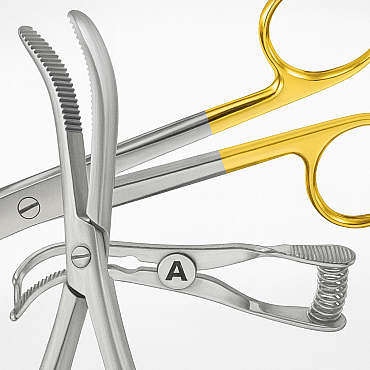
Needle holders with tungsten carbide inserts are designed to provide a secure grip during delicate suturing. The TC inserts improve durability and are often identified by gold-colored handles.
Product pages provide overall lengths, weights where applicable, tip geometry and intended applications, helping customers select suitable instruments.
Surgical instruments are not universal tools: each is designed for a specific tissue type, access situation or procedure. VUBU-MEDICAL covers the main clinical fields of application.
Metzenbaum scissors are used for blunt and sharp dissection of delicate tissue. Mayo scissors are used for tougher tissue and fascia. Potts scissors are used in vascular surgery. Bandage scissors and dissecting scissors complement the range for everyday clinical use and wound care.
Vascular clamps such as Pean, Kelly and mosquito forceps are used for hemostasis and tissue fixation. Bulldog and DeBakey clamps are used in vascular surgery. Tissue and intestinal grasping forceps support atraumatic handling of organs and bowel. Towel clamps secure surgical drapes. Overholt clamps, ring forceps, Wertheim clamps and aortic clamps are used in specialized thoracic and gynecological procedures.
Wound retractors such as Langenbeck, Hohmann, Roux and Fritsch hooks keep the surgical field open. Self-retaining retractors allow the surgeon to work with both hands. Laparoscopic retractors and arthroscopic instruments extend the selection for minimally invasive procedures.
Micro needle holders in standard and TC versions, along with surgical and dressing forceps, are used for suturing and tissue handling. The right instrument depends on the suture material, depth and tissue type.
Sponge-holding forceps, curved dressing forceps, Rampley forceps and biopsy forceps or punches cover applications from basic wound care to tissue sampling. Tenaculum forceps are used in gynecology. Luer rongeurs are used in orthopedics and neurosurgery for bone and disc tissue.
Surgical probes (such as Bowman probes) are used to explore ducts and canals in ENT and ophthalmology. Bougies and obturators are used to dilate openings and body cavities. Trocars and cannulas provide access for puncture and minimally invasive surgery.
Nasal and Sims specula are used to examine the nasal cavity and vaginal canal, respectively. A Wartenberg wheel tests superficial skin sensation in neurology. A laryngoscope is used to examine the airway and assist intubation.
Periosteal elevators separate the periosteum from bone in orthopedic and trauma surgery. Curettes remove bone material, granulation tissue or mucosa. Scalpel handles and blades in various sizes enable precise incisions.
Obstetrical forceps are used in assisted delivery. Gynecological instruments such as Fritsch retractors, tenaculum forceps and Sims specula are used in specialized gynecological procedures.
Many surgical instruments – clamps, scissors, needle holders, retractors, forceps and probes – are also used in veterinary surgery, subject to suitability for the intended procedure.
Proper reprocessing is essential to the long-term function and hygienic safety of surgical instruments. VUBU-MEDICAL instruments are described as suitable for manual and automated reprocessing.
After use, instruments should be treated according to the manufacturer’s validated instructions to prevent blood and tissue residues from drying. Automated cleaning in a washer-disinfector is generally preferred where permitted. Suitable cleaning agents must be selected for the instrument materials.
Cleaning is followed by thermal disinfection in a washer-disinfector (an A0 value of at least 3000 is commonly recommended for critical instruments). Chemical disinfection may be used where validated but is not a general substitute for an appropriate validated reprocessing process.
The instruments are described as autoclavable at 134 °C using a pre-vacuum cycle (3-minute holding time). Hollow instruments, such as grooved directors and hollow probes, bougies and obturators, require an appropriate validated sterilization process. Suitable sterilization containers or pouches in accordance with EN ISO 11607 are recommended for sterile storage.
Before reuse, inspect instruments for corrosion, deformation, cracks and correct function. Check joints and ratchets on Kelly clamps, needle holders and Allis forceps. Inspect TC inserts for chipping. Scissors such as Metzenbaum, Mayo and bandage scissors may require professional sharpening when blunt.
Sterile instruments should be stored dry, protected from dust and mechanical damage. Instrument trays and padded cassettes protect delicate tips, particularly on dressing forceps, splinter forceps and Adson-Brown forceps.


All instruments are certified according to: