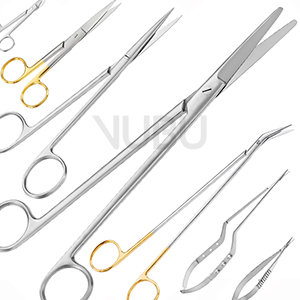


At VUBU-Medical, you will find professional-grade surgical scissors for hospitals, medical practices and outpatient procedures. Our range includes dissecting scissors, tissue scissors, bandage scissors and numerous specialty-specific models. The choice of instrument depends on the type of tissue, cutting task, surgical access and blade and tip configuration.
VUBU-Medical supplies medical scissors for professional use in hospitals, practices and operating rooms, with a focus on precision workmanship and appropriate instrument designs.
From dissecting and general-purpose scissors to specialized models for ophthalmology, gynecology, ENT surgery and dental surgery.
Choosing the appropriate design facilitates access to the surgical site and supports controlled cutting.
Sharp/sharp, blunt/blunt and sharp/blunt tips, along with selected Supercut and tungsten carbide (TC) versions for different requirements.
Clearly organized product groups and technical variants help hospitals and practices select suitable instruments.
Many medical-grade stainless steel models are intended for validated cleaning, disinfection and sterilization in accordance with the manufacturer's instructions.
Applications range from general and visceral surgery to orthopedics, ophthalmology and microsurgery.
Surgical scissors are essential instruments in operative procedures. Depending on the model, they are used to cut tissue, sutures, drainage tubing or dressing materials. Selecting suitable scissors helps ensure controlled cutting and gentle tissue handling.
For accessible, superficial cutting areas and appropriate materials. They allow direct guidance along the cutting line.
Improve visibility of the blade tips and access to deeper tissue layers.
Tip configuration influences how the instrument behaves during insertion and cutting. It must be appropriate for the tissue and surgical technique.
Classic curved dissecting scissors for selected delicate tissue dissections.
Long shanks and comparatively short blades for delicate dissection of sensitive soft tissue, for example in visceral, vascular and plastic surgery.
More robustly constructed for cutting firmer tissue structures such as fascia and, depending on the design, other resistant tissues.
Choose the appropriate instrument category. The links lead directly to the corresponding VUBU-Medical English-language subcategories.
Fine scissors for controlled tissue separation and dissection. Straight and curved versions, including Metzenbaum and Cooper models, support work on delicate soft tissue.
Versatile scissors for routine tasks in the operating room. Available with sharp/sharp, blunt/blunt or sharp/blunt tips, and in straight or curved designs, depending on the application.
For cutting bandages, clothing and suitable dressing materials. Protective tip designs can help protect the skin when removing dressings.
Fine instruments for precise cuts in ophthalmic surgery. Different tip and blade geometries allow selection according to the surgical technique.
Specialized scissors for anatomical dissection and cutting various tissue structures in visceral surgery and other surgical specialties.
Instruments for cutting suitable wires and materials in dentistry, orthodontics and related fields.
Scissors designed for obstetric applications, with blade shapes tailored to their intended purpose.
Specialized scissors for dissection and tissue separation in gynecological procedures.
Particularly fine scissors for selected ophthalmic and microsurgical procedures.
Scissors for precise cutting of ligatures and suture material; blade and tip configuration should suit the application.
For dermatological, podiatric and minor surgical procedures, with appropriately adapted blade shapes.
Specialized instruments for different applications in orthopedics and ophthalmology; model selection depends on the tissue involved.
Scissors for ear, nose and throat procedures, particularly tonsil surgery.
Selected models with tungsten carbide cutting edges or Supercut blade geometry for precise cutting and high wear resistance.
The appropriate scissors depend on the surgical discipline and procedure, not simply the size of the instrument.
Dissecting, Metzenbaum and Mayo scissors for tissue separation, dissection and a variety of cutting tasks.
Fine blades and controlled handling for delicate structures; specialized dissecting scissors or micro scissors are used depending on the procedure.
More robust scissors for firmer tissues and selected specialized scissors for tendons and other structures.
Gynecological scissors as well as episiotomy and umbilical cord scissors for defined obstetric applications.
Eye, iris, iridectomy and corneal scissors with fine tips for small surgical fields.
Tonsil scissors and other specialized scissors for procedures in anatomically confined areas.
Skin and nail scissors for appropriately selected cutting tasks.
Gingival scissors, wire cutters and crown scissors for dental and orthodontic applications.
Many reusable surgical scissors are made from corrosion-resistant medical-grade stainless steel. Specific material specifications vary by model.
Different blade shapes support controlled cutting in superficial and deeper anatomical structures.
Sharp/sharp, blunt/blunt and sharp/blunt configurations, as well as fine or more robust blades for specific applications.
Selected scissors feature specialized blade geometries for controlled, precise cutting.
On appropriately equipped models, tungsten carbide inserts can improve blade wear resistance and service life.
Reusable models must be reprocessed according to the relevant manufacturer's instructions. Approved methods and parameters are specified in the instructions for use.
Suitable handle geometry, smooth joint movement and correctly aligned blades support precise handling.
Fine dissecting scissors for delicate soft tissue, stronger scissors for firmer tissues and specialized scissors for specific clinical applications.
The following information provides general guidance. The instructions for use of each instrument and the facility's validated reprocessing procedures always take precedence.
Remove residues promptly after the procedure in accordance with applicable protocols and avoid allowing contamination to dry whenever possible.
Use only manual or automated methods approved for the particular instrument. Pay special attention to joints and blades.
Check blades, tips, joints and surfaces for damage, corrosion and proper cutting performance.
If required, treat joints with approved instrument-care products and prepare instruments for sterilization as instructed.
Use only validated sterilization parameters approved by the manufacturer. Suitability for conditions such as 134°C depends on the product.
Dry instruments thoroughly and store them protected in suitable systems. Remove damaged or blunt scissors from service.
Metzenbaum scissors are designed for finer dissection of delicate soft tissue. Mayo scissors are more robust and suitable for firmer tissue such as fascia.
Straight scissors are often suitable for superficial cutting and materials. Curved scissors can improve visibility and access in deeper surgical fields.
Common configurations include sharp/sharp, blunt/blunt and sharp/blunt. The choice depends on the tissue, cutting task and safety requirements.
Supercut refers to specialized blade geometries on selected scissors designed for precise cutting. The exact configuration depends on the model.
On suitable models, tungsten carbide inserts can improve blade wear resistance and extend service life.
Many reusable scissors are suitable for steam sterilization. However, approved methods, temperatures and cycles must be checked against the relevant manufacturer's instructions.
Depending on the procedure, eye, iris, iridectomy and corneal scissors may be used. Their fine blades are designed for small and delicate surgical fields.
The corresponding subcategories are linked directly above in the “All Types of Surgical Scissors at a Glance” section.
In addition to surgical scissors, VUBU-Medical also offers medical forceps, surgical clamps and forceps and other surgical instruments.


All instruments are certified according to: