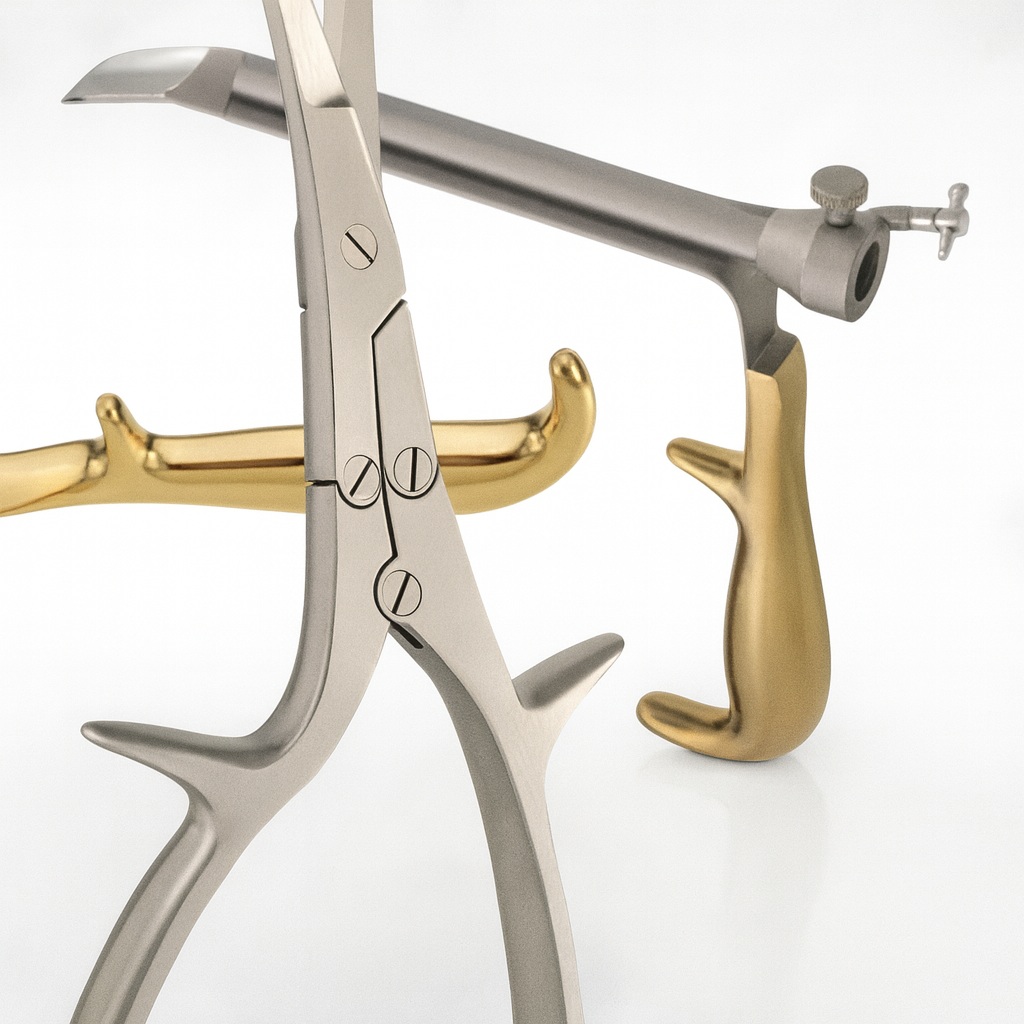


At VUBU-MEDICAL, hospitals, specialist practices and operating centres can explore a dedicated range of instruments for plastic, aesthetic and reconstructive surgery. From breast dissectors, areola markers and illuminated mammoplasty retractors to liposuction cannulas, nasal rasps, rhytidectomy scissors and maxillofacial retractors, compare instruments by working geometry, dimensions, connections and intended use.
The specialist information below helps you select instruments for mammoplasty, liposuction, rhinoplasty, facelifts, abdominoplasty and oral and maxillofacial surgery. The specifications and intended use of each individual product always take precedence.
VUBU-MEDICAL is based in Tuttlingen, an internationally recognised centre of medical technology. The origin and actual place of manufacture must be assessed for each product individually.
Applicable medical device regulations depend on the individual product. CE marking and documentation are product-specific; ISO 13485 is a quality-management-system standard.
The shop rating of 4.79/5 from 228 reviews is an important indicator of customer confidence (figure shown in the category text reviewed in November 2026).
Purchase on account is available to doctors and businesses subject to the applicable shop terms.
No minimum order value. According to the published shop terms, shipping within Germany is free from €100; eligible in-stock products are generally listed with delivery times of 2–5 working days.
The range includes numerous instrument variations for aesthetic and reconstructive procedures; the category currently lists more than 700 products.
Established patterns such as Agris-Dingman, Tebbetts, Ferriera, Aufricht, Cottle, Daniel and Ramirez help clinicians identify instruments for different surgical techniques.
Individual instruments can be assembled into a custom surgical tray on request and combined with suitable sterilisation containers. Tray configuration and reprocessing must be appropriate for the intended use.
Customer experiences with the VUBU-MEDICAL shop. These reviews concern orders placed with the shop and do not necessarily refer to instruments in this category.
“We have received 50 pieces of these evacuators. Very well packaged and of excellent quality. Thank you very much.”
“Very affordable and really good. We will order more instruments here.”
Different stainless-steel grades and surface finishes may be used depending on the instrument. Corrosion resistance and suitable reprocessing depend on the material, construction and manufacturer’s instructions.
Working length, overall length, curvature, blade width, number of prongs and tip design affect access and handling in the surgical field.
Some scissors feature tungsten-carbide (TC) inserts; other models use specialised cutting-edge geometries. TC, Supercut and standard versions are not interchangeable descriptions.
Depending on the model, nasal and mammoplasty retractors may incorporate light guides and suction tubes. Connections and adapters for Storz, Wolf or Olympus systems must be checked before ordering.
Handle-connection and Luer-Lock cannulas use different connection systems. Also check diameter, length, port configuration and system compatibility.
Check each instrument’s intended use, labelling, manufacturer documentation and approved cleaning and sterilisation methods.
The following categories are organised by clinical application and instrument design. Each linked category name leads to a different specialist section of the English-language shop.
Breast dissectors and elevators support controlled dissection and exposure of tissue planes in breast surgery. Options include graduated left- and right-handed Agris-Dingman patterns and various elevators. Rounded working ends can support careful tissue handling but cannot eliminate the risk of injury.
Breast markers, measuring calipers and gauges support preoperative planning. Areola markers in various diameters, Castroviejo calipers and Jameson measuring instruments help mark distances, contours and symmetry consistently.
Breast spatulas and tongue depressors are used for retraction and exposure. Their shape, width and flexibility vary; selected models incorporate light guides and suction tubes for illumination or aspiration.
Nasal retractors, thumb hooks and bear-claw retractors include Aufricht retractors, some with light guides, and Anderson retractors with different numbers of prongs. They assist exposure in rhinoplasty and reconstructive procedures; sharp hooks require particularly controlled handling.
Nasal rasps, osteotomes and cartilage crushers are used, depending on the technique, to shape bony and cartilaginous structures. Rasps vary in coarseness, curvature and cutting direction, including Aufricht-Wiener patterns that cut on the push or pull stroke.
Cottle- and Killian-pattern nasal specula help expose the nasal cavity. Working length, blade geometry and spreading mechanism should be selected for the intended procedure.
Rhytidectomy scissors for facelift and neck-lift surgery are available in different lengths, curvatures and cutting-edge designs. Fine dissection geometry and model-specific TC options are relevant selection criteria.
Skin hooks and retractors in patterns such as Freeman, Gorney and Barsky help hold and expose skin and soft tissue during facial surgery and body-contouring procedures.
Daniel- and Ramirez-pattern endo dissectors are designed for specialised dissection and access techniques. Shape and working length must match the intended endoscopically assisted or open approach.
Maxillofacial instruments include intraoral and extraoral retractors for oral and maxillofacial surgery. Examples include anatomically shaped retractors for exposure during reconstructive procedures.
Tebbetts-style mammoplasty retractors are available in different blade widths and lengths, sometimes with serrated working surfaces, light guides and suction. The specifications of the selected model determine its features.
Ferriera-style retractors have different blade and jaw geometries from Tebbetts models. Check the product description for smooth working surfaces, illumination and suction options.
Facelift and breast-plastic-surgery illuminated retractors are designed for different surgical approaches. Blade angle, length, illumination and optional suction vary by model.
Handle-connection liposuction cannulas are designed for compatible handle systems. In addition to the connector, compare diameter, effective working length, tip geometry and aspiration-port placement.
Luer-Lock liposuction cannulas use a different connection design. For tumescent infiltration and aspiration, verify actual system compatibility and the instrument’s stated intended use.
Liposuction cannulas vary in working length, diameter, port pattern, tip shape and connection. Different designs are intended for the abdomen, hips, limbs and smaller treatment areas. Selection depends on the surgical technique and the suction or infiltration system used.
Agris-Dingman dissectors, elevators, areola markers, breast spatulas and mammoplasty retractors support different stages, from marking and dissection to exposure of the implant pocket. The instrument set depends on the surgical approach and technique.
Aufricht nasal retractors, Anderson retractors, nasal specula, rasps, osteotomes and cartilage crushers serve different purposes. Rasp cutting direction, working angle, prong design and access depth are especially important.
Rhytidectomy scissors, delicate skin hooks, retractors and specialist facelift instruments support different dissection and retraction steps. Key selection criteria are the intended tissue handling and instrument geometry.
Abdominoplasty and other body-contouring procedures may require retractors and hooks to expose skin and soft tissue. Blade width, length and hook geometry should match the planned surgical approach.
Intraoral and extraoral retractors assist exposure in corrective jaw surgery, reconstruction and other oral and maxillofacial procedures. Anatomical shape and working length are important.
Check working length, overall length, curvature, prong count, blade width and cutting-edge or jaw design. Small differences can significantly affect handling.
An instrument pattern name does not replace technical specifications. Compare blade geometry, serrations, light-guide configuration and suction options for each product.
For cold-light systems, check connector standards, light sources and required adapters. Compatibility with Storz, Wolf or Olympus cannot be assumed for every model.
TC refers to tungsten-carbide inserts, whereas Supercut describes a cutting-edge design. Select the version appropriate to the procedure and the manufacturer’s specifications.
Reprocessing must follow the instrument’s intended use and the manufacturer’s instructions. The following five steps are general guidance for professional reprocessing facilities.
After use, pre-treat and clean instruments promptly in accordance with the manufacturer’s instructions. Fine tips, joints and lumens require suitable procedures; not every instrument may be soaked.
Use suitable validated manual or automated disinfection procedures. Check material compatibility, particularly for light guides, coatings and combined instruments.
Use only sterilisation processes and parameters approved by the manufacturer. It is not safe to assume that every instrument tolerates an identical 134 °C cycle and holding time.
Inspect blades, joints, prongs, retractor surfaces, light guides, suction channels and connectors for residue, damage and proper function. Remove damaged instruments from service.
Store cleaned and reprocessed instruments dry and protected in accordance with hygiene requirements. Suitable trays, holders and containers help protect delicate working ends.


All instruments are certified according to: