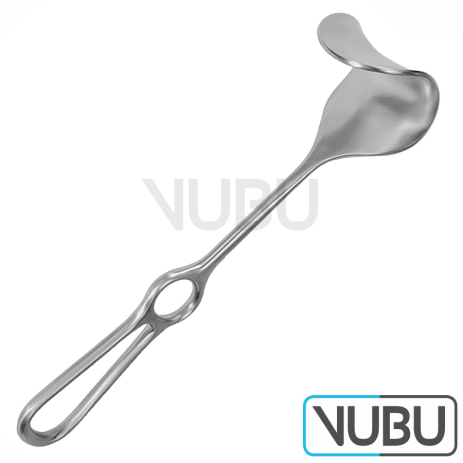


Definitive Deep Retractor with Maximum Profile for Demanding Retraction of Massive Tissue Layers
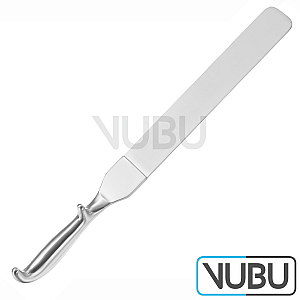
The FRITSCH RETRACTOR with fenestrated handle, Figure 4, is a CE Class I medical device manufactured according to ISO 13485:2016. As the largest and deepest standard version of the classical Fritsch series, this instrument is specifically designed for the powerful, broad, and controlled retraction of massive, deep-lying tissue. Its exceptional blade profile of 45 mm width and 75 mm depth provides the stability and control required for the most demanding deep surgical approaches in general, visceral, and orthopedic surgery.
Product Highlights:
✔ Certified according to ISO 13485:2016
✔ CE marking Class I (Regulation (EU) 2017/745 MDR)
✔ Maximum standard design "Figure 4" with deepest blade (75 mm)
✔ Highly stable, anatomical fenestrated handle for secure grip and optimal force transmission under full load
✔ Exceptional blade dimensions: 45 mm width, 75 mm depth – for large tissue volumes
✔ Fully rounded, high-gloss polished edges for supreme tissue protection
✔ High-quality surgical stainless steel in a reinforced version – rust-proof and biocompatible
✔ Optimal length of 24.0 cm for powerful leverage in depth
✔ Autoclavable and designed for long-term intensive use in clinical settings
Benefits of the Fritsch Retractor (Fig-4 with Fenestrated Handle):
• Ultimate Deep Tissue Effect: The 75 mm deep blade is capable of securely encompassing and controllably holding aside massive muscle packages or organs where smaller retractors fail.
• Balanced Force Transmission: The reinforced fenestrated handle ergonomically distributes the required traction force and prevents hand cramping even during long, forceful applications.
• Maximum Stability: Provides an exceptionally stable and broad contact surface, reliably preventing slipping or tearing of the held tissue.
• Atraumatic Despite Size: The careful polishing and rounding of all contours ensure gentle interaction even with sensitive tissue.
• Instrument of Choice for Maximum Approaches: The definitive standard instrument for the largest open abdominal, orthopedic, or urological approaches.
Technical Specifications:
• Model: Fritsch Retractor, lateral, Figure 4 (with fenestrated handle) – Maximum Version
• Overall Length: 24.0 cm
• Blade Dimensions (W x D): 45 mm x 75 mm
• Blattform: Rectangular/oval with strongly rounded corners, straight
• Handle Form: Reinforced anatomical fenestrated handle
• Material: High-quality surgical stainless steel (e.g., 1.4301 / 316L)
• Surface: High-gloss polished (mirror finish) for optimal gliding properties
• Special Feature: Deepest standard blade of the Fritsch series for maximum tissue control
• Risk Class: I according to Regulation (EU) 2017/745 MDR
Areas of Application:
• Maximum retraction in major laparotomies and extensive visceral surgical procedures
• Orthopedic approaches to deep-lying structures such as hip joint, spine, or proximal femur
• Comprehensive urological procedures (e.g., radical cystectomies, nephrectomies)
• Major vascular surgical reconstructions
• Oncological resections with large access windows
Important Safety Instructions:
• FOR USE BY EXPERIENCED SURGICAL PERSONNEL ONLY.
• Use under aseptic conditions only.
• Inspect for structural integrity, especially at the critical transition from handle to blade, before each use.
• The significant leverage and blade depth require particularly conscious and measured handling. Uncontrolled force can lead to substantial tissue damage.
• When placing in depth, special caution is required due to the large blade area to avoid compressing underlying critical structures (neurovascular bundles).
• When reusing, reprocessing guidelines must be strictly followed; cleaning the deep blade and fenestrated handle requires particular care.
Write the first Review!


All instruments are certified according to: